Exploring the Next Frontier: Spatial Proximity Sequencing
Key takeaways
- Sprox-seq (Spatial Proximity-Sequencing) combines proximity ligation with a spatial platform to map protein-protein interactions in tissue while preserving spatial coordinates.
- Oligo-tagged antibody pairs form PLA products only when target proteins are within about 50 nm, and a USER-enzyme step lets PLA products and mRNAs be co-captured via spatial barcodes.
- In human tonsil germinal centers the method profiled 32 proteins, 528 pairwise protein interactions, and thousands of mRNAs, revealing more complexity in the Light zone than RNA analysis alone.
- The team built a custom AOC panel with proximity-ligation-compatible oligo tags, showing why broadly available, customizable conjugates are needed for routine spatial proximity mapping.
Following up on our scientific techniques using antibody-oligonucleotide conjugates summary, we wanted to highlight a paper that takes spatial biology to the next level: measuring not just where proteins are, but which proteins are physically interacting in tissue.
The Problem
Spatial Biology tells us about protein abundance and location, but proteins rarely act alone. Understanding which proteins are actively forming complexes—and where this happens in tissue—has required separate, low-throughput assays. As the field evolves from Genomics → Proteomics → Spatial Biology, the next frontier is capturing the spatial context of protein-protein interactions.
The Solution
Sprox-seq (Spatial Proximity-Sequencing) builds on the team's earlier Prox-seq method, combining proximity ligation with a spatial platform. Oligo-tagged antibody pairs form proximity ligation assay (PLA) products only when their target proteins are physically close (~50 nm), enabling direct detection of protein complexes alongside mRNA, all with spatial coordinates preserved.
Key Achievements
- Profiled 32 proteins, 528 pairwise protein interactions, and thousands of mRNAs across human tonsil germinal centers
- Protein interaction mapping revealed much higher complexity in the Light zone than RNA-based analysis alone
- Developmental trajectories inferred from protein interactions uncovered a B cell maturation pathway distinct from that inferred by RNA
- Captured B cell–Follicular Dendritic Cell interactions mediated by the VLA-4–VCAM1 complex in situ
How Were the AOCs Designed?
Notably, the team designed their own custom antibody panel with proximity-ligation compatible oligo tags rather than relying solely on supplier content, demonstrating the flexibility researchers need when pushing beyond standard spatial workflows.
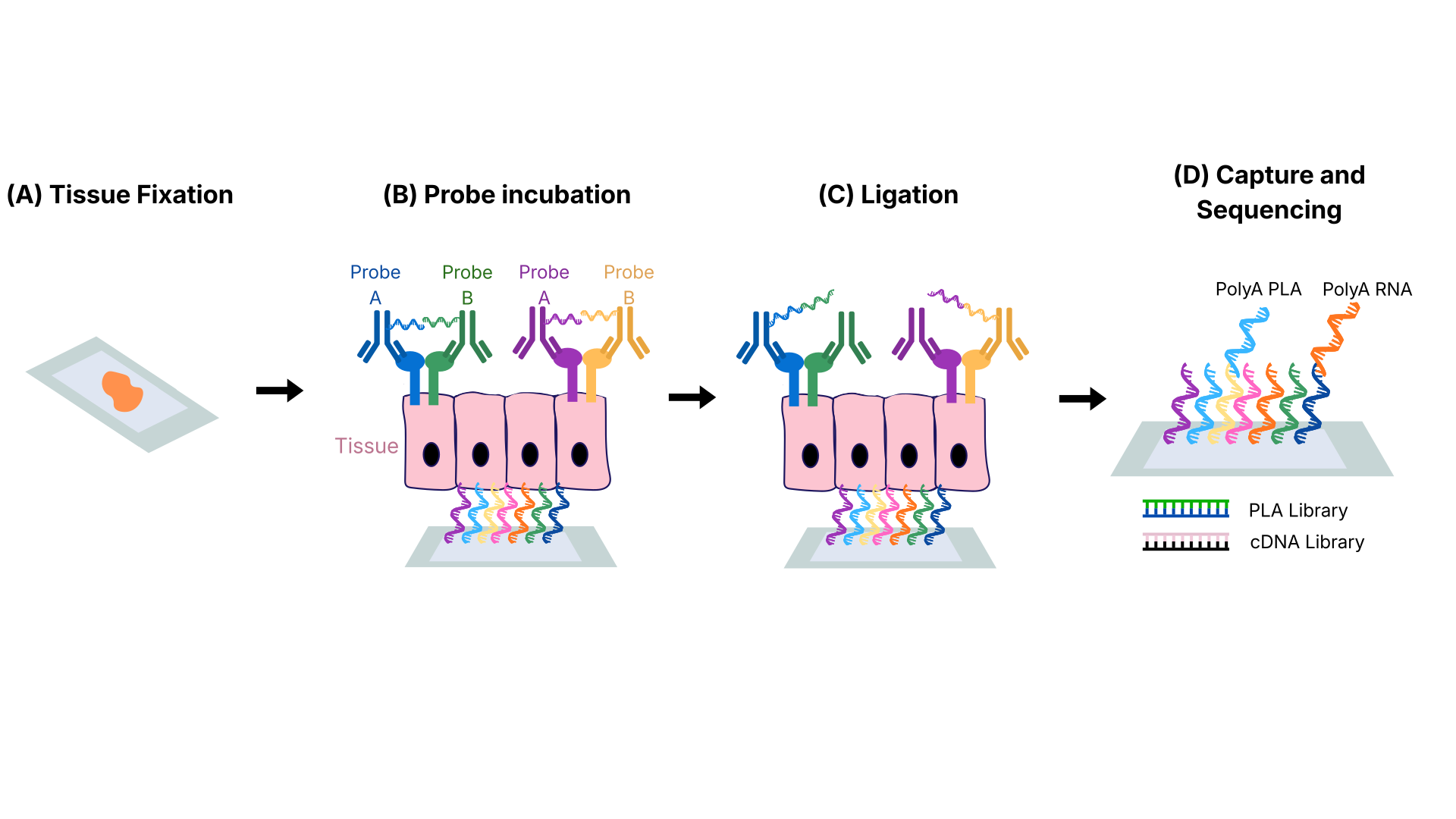
Figure 1. Sprox-seq workflow. Tissue sections are fixed (A) onto slides and incubated with antibody-oligo conjugate pairs (B). When in proximity, the oligo probes are ligated (C) and treated with USER enzyme to expose a poly(A) tail, enabling co-capture of PLA products and mRNAs via spatial barcodes.
What Will It Take for Widespread Adoption?
The technology elegantly demonstrates that spatial proximity is information-rich and biologically distinct from gene expression data. But scaling these approaches will require:
- Panels of AOCs for proximity detection
- Compatibility with various spatial platforms
- Broad availability of conjugates that researchers can customize without starting from scratch
The focus of AbOliGo is to make AOCs accessible to all, thus allowing spatial proximity mapping to move from specialized applications to routine tissue analysis.